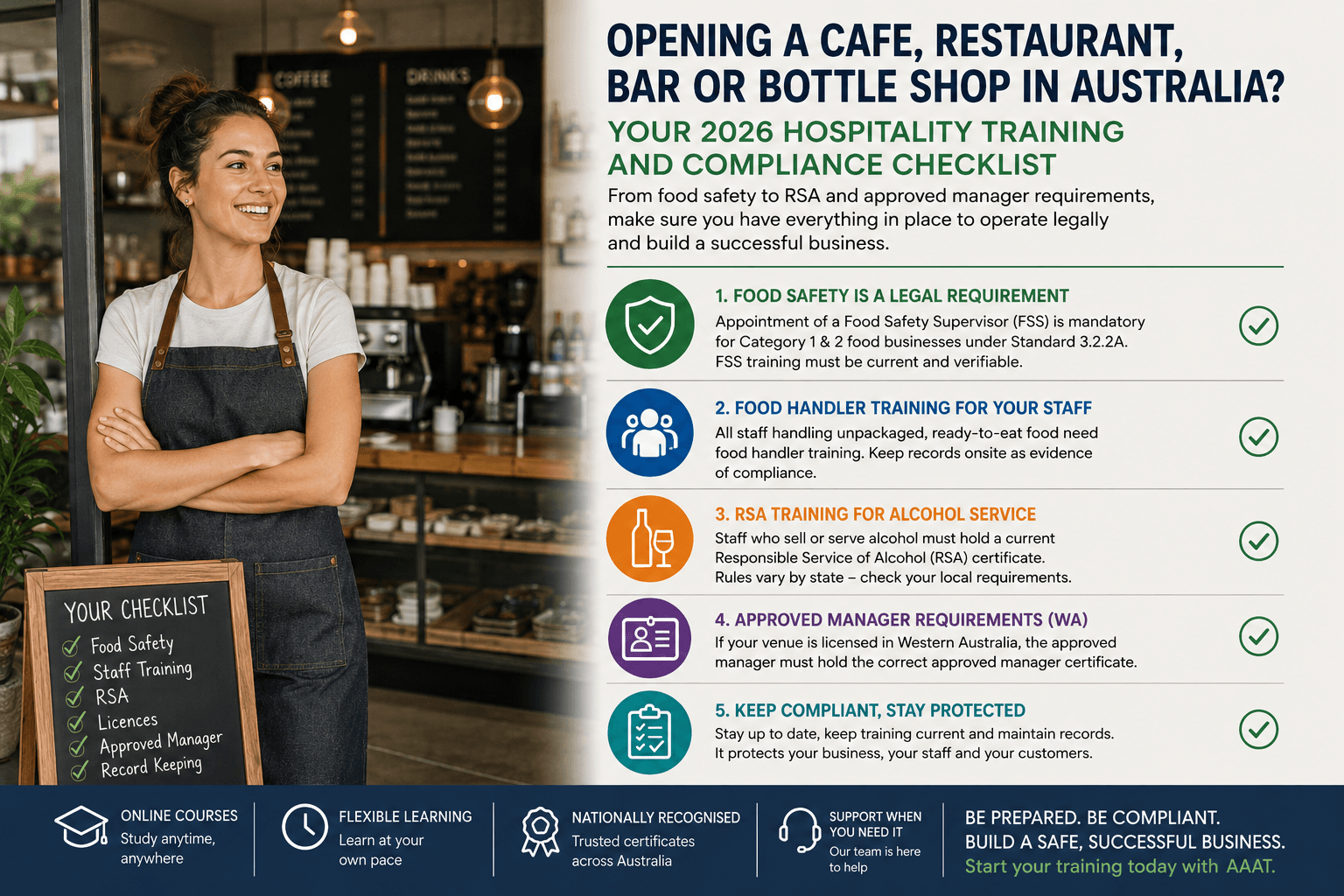
Opening a Cafe, Restaurant, Bar or Bottle Shop in Australia?
Your 2026 Hospitality Training and Compliance Checklist
Opening a hospitality business is not just about the menu, fit-out, staffing roster or launch campaign. Before the first busy shift, the business also needs a clear plan for the training and compliance responsibilities that apply to the venue, the work being performed and the state or territory where the business operates.
A cafe serving breakfast, a restaurant offering wine, a takeaway shop preparing ready-to-eat meals, a pub, a bottle shop and a catering business can each have different obligations. The mistake is assuming that one certificate covers every person, every role and every location.
This practical checklist will help owners, venue managers and hospitality workers identify the training areas that should be reviewed before opening, expanding a team or assigning new duties. It is a general guide only. Always confirm your specific obligations with the relevant regulator, local authority and licensing body.
Quick answer
Many hospitality businesses need to review more than one training pathway. Staff who sell, supply or serve alcohol may need RSA training. Workers handling relevant food may need food-safety knowledge or training. Certain food businesses need a certified Food Safety Supervisor. Licensed venues may also have manager-level requirements, including WA Approved Manager requirements where applicable.
Start with the Activities Taking Place at Your Business
Do not start by asking which certificate is cheapest or fastest. Start by mapping what your team will actually do. A single employee may perform several duties during one shift, and each duty can trigger a separate training question.
Use the following questions as your first review:
• Will any staff member sell, supply or serve alcohol?
• Will the business prepare, display or sell unpackaged ready-to-eat food?
• Will staff handle potentially hazardous food such as meat, eggs, dairy, seafood, cooked rice, cooked pasta or cut fruit and vegetables?
• Does the business need a certified Food Safety Supervisor?
• Will the venue operate under a liquor licence?
• Does the venue require a trained or approved manager under the relevant state or territory rules?
• Are new staff moving from another state and relying on an existing RSA certificate?
• Are certificates current, suitable for the role and accepted in the jurisdiction where the person will work?
The Fast Role-by-Role Training Check
The training requirements for hospitality staff depend on the duties they perform. A single employee may need to review more than one training pathway if their role includes alcohol service, food handling or supervisory responsibilities.
Use the following guide as a starting point:
Bar Staff, Wait Staff and Bottle-Shop Staff
Staff members who sell, supply or serve alcohol should review the RSA requirements that apply in the relevant state or territory. Food-safety training may also be relevant if the person handles food as part of their role. Entry-level staff will not usually need manager-level training unless they are assigned supervisory responsibilities.
Cafe and Restaurant Staff Handling Food
Staff members who prepare, serve or handle food should review the Food Handler training requirements relevant to their work. RSA training may also be required if they serve or supply alcohol. Supervisors should also check whether the business needs Food Safety Supervisor coverage.
Kitchen Staff Preparing Ready-to-Eat Food
Kitchen staff should review the food-safety training requirements that apply to their duties. RSA training will generally not be relevant unless the person also sells, supplies or serves alcohol. The business should also confirm whether a certified Food Safety Supervisor needs to be appointed.
Food Safety Supervisors
A Food Safety Supervisor should hold the appropriate certification and be reasonably available to advise and supervise food handlers. RSA training may also be relevant if the person serves or supplies alcohol as part of their role.
Venue Managers at Licensed Premises
Venue managers should review the RSA requirements that apply to their duties and location. Food-safety training may also be relevant if they supervise or participate in food-handling activities. Depending on the jurisdiction and licence type, additional manager-level requirements may apply.
Managers at WA Licensed Premises
Managers working at licensed premises in Western Australia should review the relevant RSA pathway and confirm whether they need to follow the WA Approved Manager application pathway. Food-safety training may also be relevant depending on the duties performed.
Catering and Event Staff
Catering and event staff should review RSA requirements if alcohol will be served or supplied. Food Handler training may also be relevant where staff prepare, serve or handle food. Additional event, venue or licensing conditions may apply depending on the location and nature of the event.
Checklist 1: Will Your Team Sell, Supply or Serve Alcohol?
Responsible Service of Alcohol (RSA) requirements are central to licensed hospitality work. The exact rules vary between states and territories, so businesses should not assume that a certificate used in one jurisdiction will automatically satisfy every requirement in another.
As a practical rule, review RSA requirements for anyone involved in the sale, supply or service of alcohol, including relevant bar staff, floor staff, room-service staff, bottle-shop staff and managers. In Queensland, for example, the official guidance states that most staff serving or supplying alcohol at licensed premises, including licensed restaurants and cafes, must have an RSA certificate. In NSW, RSA training is mandatory for people selling, serving or supplying alcohol, and workers need a competency card.
Before assigning alcohol-service duties, confirm:
• the worker has completed the correct RSA training for the jurisdiction;
• the certificate, statement of attainment or competency card is current where expiry or renewal rules apply;
• an interstate certificate is accepted or whether a bridging process is required;
• the employer retains the records required by the relevant regulator;
• staff understand that holding a certificate is only the starting point - responsible service procedures still need to be followed during every shift.
AAAT course pathway: View online RSA courses
Checklist 2: Will Your Team Handle Food?
Food-service businesses should review the food-safety responsibilities that apply to their activities before staff begin handling food. Standard 3.2.2A introduced food-safety management tools for food service, catering and related retail businesses handling unpackaged, potentially hazardous food that is ready to eat.
The three tools are food-handler training, appointment of a Food Safety Supervisor and substantiation of critical food-safety controls. The tools that apply depend on the category of business and its activities.
Review whether your business handles:
• ready-to-eat meals prepared onsite;
• unpackaged food displayed for sale;
• sandwiches, salads or takeaway meals;
• meat, poultry, eggs, seafood or dairy products;
• cooked rice, cooked pasta or other food requiring time and temperature control;
• food served through catering, events, pubs, cafes, restaurants, takeaway shops, supermarkets, delis or food vans.
If the answer is yes, the business should review whether formal food-handler training is the appropriate pathway for team members and whether the business must appoint a certified Food Safety Supervisor.
AAAT course pathway: View Food Handler and Food Safety Supervisor courses
Checklist 3: Does Your Business Need a Food Safety Supervisor?
A Food Safety Supervisor (FSS) is not just a certificate stored in a folder. The role is intended to provide practical oversight. Under Standard 3.2.2A, category-one and category-two businesses must appoint a certified FSS before engaging in prescribed high-risk food-handling activities. The FSS must be reasonably available to advise and supervise food handlers.
FSANZ guidance states that the FSS should be involved in day-to-day operations and have the authority and ability to manage safe food handling. Appointing someone who never works onsite or is not meaningfully involved in normal operations may not satisfy the intent of the requirement.
Before opening or expanding your food operation, check:
• whether your business is category one or category two under Standard 3.2.2A;
• whether a certified FSS has been appointed;
• whether the FSS certificate was issued within the required five-year period;
• whether the FSS is reasonably available to advise and supervise staff;
• whether food-handler knowledge, training and records are being managed consistently;
• whether category-one evidence requirements apply to the business.
AAAT course pathway: View Food Safety Supervisor training options
Checklist 4: Are You Operating a Licensed Venue in Western Australia?
Western Australian licensed venues need to review manager-level obligations separately from basic RSA training. A person seeking to become an approved manager must follow the relevant WA application pathway. The appropriate pathway depends on the type of approved manager card required.
WA guidance distinguishes between restricted and unrestricted approved manager cards. A restricted approved manager card is limited to certain licence types, while an unrestricted approved manager card allows work at any licensed venue in Western Australia, including an occasional venue. The unrestricted pathway requires completion of the Course in Management of Licensed Premises, with RSA as a prerequisite.
Before appointing a manager at a WA licensed venue, confirm:
• the type of approved manager card required;
• the correct training pathway has been completed;
• the application has been lodged with the relevant department;
• the applicant has the required supporting documents, including a recent national police certificate where applicable;
• the business has a plan for leave, roster changes and manager-card expiry dates.
AAAT course pathway: View the WA Approved Manager course
Checklist 5: Build a Training Register Before the First Shift
The best time to identify a missing certificate is before a staff member is rostered into a regulated duty. A simple training register can reduce avoidable gaps as employees join, move roles or work across multiple locations.
Your register should record:
• employee name and role;
• venue or work location;
• duties assigned to the employee;
• course completed;
• certificate or competency-card details;
• date completed;
• expiry or refresher date, where applicable;
• interstate recognition or bridging requirements;
• manager-card status, where relevant;
• the next internal review date.
For multi-site businesses, the register should be reviewed whenever a worker moves to another venue or takes on additional duties. A certificate that was suitable for one role or jurisdiction may not automatically cover the next one.
The 10-Minute Pre-Opening Compliance Review
Before your first trading day - or before the next new employee starts - run this quick review:
1. List every activity staff will perform: alcohol service, food preparation, food handling, supervision and licensed-venue management.
2. Match each activity to the relevant training question.
3. Check state or territory requirements rather than relying on assumptions.
4. Confirm whether any existing interstate certificates are accepted.
5. Identify whether Food Safety Supervisor coverage is required.
6. Check whether a WA Approved Manager pathway applies to the venue.
7. Collect and store evidence of completed training.
8. Record any expiry, renewal or refresher dates.
9. Add certificate checks to onboarding and roster-change procedures.
10. Review the register regularly, especially before peak periods and staff turnover cycles.
Common Mistakes to Avoid
• Assuming RSA rules are identical across Australia.
• Treating Food Handler training and Food Safety Supervisor training as the same thing.
• Appointing an FSS who is not reasonably available to supervise staff.
• Waiting until an inspection, busy trading period or staff resignation exposes a gap.
• Rostering staff into duties before checking certificates and jurisdiction-specific requirements.
• Forgetting to track expiry, renewal and refresher dates.
• Assuming one manager-level course automatically satisfies every state or territory requirement.
What Training Should You Review First?
The priority depends on your business model:
• Opening a bar, pub, licensed restaurant or bottle shop: review RSA requirements first, then check manager-level licensing obligations.
• Opening a cafe, takeaway shop or catering business: review food-handler requirements and whether a Food Safety Supervisor is required.
• Opening a licensed restaurant: review both alcohol-service and food-safety pathways.
• Operating a licensed venue in WA: check RSA requirements and the appropriate Approved Manager pathway.
• Hiring staff from interstate: confirm whether existing certificates are accepted and whether bridging, competency-card or refresher requirements apply.
• Operating multiple locations: centralise training records and check every role change against the duties performed at each venue.
Get the Right Training Pathway Before the First Shift
Hospitality compliance is easier to manage when training decisions are made early. The goal is not to collect certificates for the sake of it. The goal is to make sure the people serving alcohol, handling food and supervising operations have the appropriate training for their actual duties and location.
Access All Areas Training (AAAT, RTO 52312) offers online training options across RSA, Food Handler, Food Safety Supervisor and WA Approved Manager pathways. Review the available courses and select the training that matches your role, state and workplace responsibilities.
Explore AAAT online courses: https://www.accessallareastraining.com.au/courses
Frequently Asked Questions
Do all hospitality workers need RSA training?
No. RSA is relevant where a worker sells, supplies or serves alcohol. The exact requirements vary by jurisdiction and role, so businesses should check the rules applying to the venue and duties performed.
Is RSA the same as a Food Handler certificate?
No. RSA relates to the responsible service of alcohol. Food Handler training relates to safe food-handling practices. A worker may need to review both pathways if their job involves both alcohol service and food handling.
Does every cafe or restaurant need a Food Safety Supervisor?
Many food-service, catering and related retail businesses handling unpackaged, potentially hazardous food that is ready to eat need to appoint a certified FSS under Standard 3.2.2A. Confirm how the standard applies to your business activities and category.
Can one employee be both the Food Safety Supervisor and a venue manager?
Potentially, depending on the employee's duties, qualifications, availability and the applicable rules. The business should confirm that the person satisfies each separate requirement and can perform each role effectively.
Can staff use an RSA certificate from another state?
Sometimes, but not automatically in every jurisdiction. Interstate recognition, bridging, competency-card and refresher rules should be checked before the worker begins relevant duties.
Do WA licensed venues need an Approved Manager?
WA licensed venues should review the Approved Manager requirements that apply to their licence type and operating arrangements. Different pathways apply for restricted and unrestricted approved manager cards.
When should a business review staff training records?
Review records before onboarding, before assigning new duties, when staff move between venues, before peak trading periods and whenever certificate expiry or renewal dates approach.
Important Note
This article provides general information only. Training, licensing and food-safety obligations vary according to the state or territory, the licence type, the business category and the activities performed. Confirm the requirements applying to your business with the relevant regulator, licensing authority and local government environmental health service.
Official Resources
• FSANZ - Standard 3.2.2A food-safety management tools
• FSANZ - Food handler training
• FSANZ - Food Safety Supervisor guidance
• NSW Government - Responsible Service of Alcohol training
• Queensland Government - RSA training and certification
• WA Government - mandatory training for licensees, approved managers and employees
About Access All Areas Training
Access All Areas Training (AAAT) has been delivering nationally accredited hospitality compliance training across Australia for over 20 years. As a registered training organisation (RTO 52312) approved by the Australian Skills Quality Authority (ASQA), AAAT has helped more than 200,000 students complete their RSA, Food Safety and Approved Manager training. AAAT is also an approved training provider under the NSW Food Authority (provider number 25813).
Disclaimer: The information in this article is provided for general guidance only and reflects regulatory requirements at the time of writing. Regulatory requirements and state-specific rules can change. Students are encouraged to verify current requirements with the relevant state or territory authority before enrolling in any course.